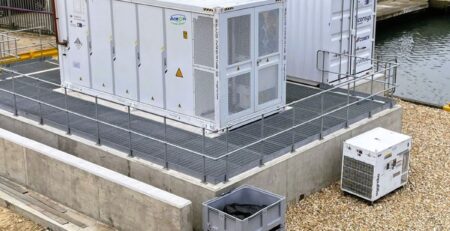

Big-battery energy storage is a game-changer for data centres. These systems offer fast, reliable power at a lower cost, helping facilities plug into the grid sooner and avoid long waits for interconnection.
They also make it easy to switch between multiple power sources without any hiccups, keeping operations smooth. As data centres add more onsite energy options, battery energy storage helps maintain steady, high-quality power at every step.
The rise of artificial intelligence is pushing energy demand into new territory. As more industries lean heavily on AI, the need for improved computing power is skyrocketing.
Data centre electricity use is expected to triple by 2028, highlighting the need for improved generation and storage.
Even if utilities could instantly add new generation, there’s another major challenge: the sharp increase in server rack power density.
Liquid-cooled AI racks consume up to eight times more power than the average rack today. This spike-and-drop pattern makes managing energy loads far more complicated than it used to be.
Layer onto that the reality of the aging grid, much of it over 60 years old, and it’s clear why data centre operators are scrambling for reliable, high-volume power solutions that can actually keep pace with AI growth.
The good news? Battery energy storage systems (BESS) are making a significant impact. They’re fast, flexible, and designed to handle the kind of rapid changes in demand that AI workloads create.
They’re already widely used to smooth out supply-and-demand timing issues on the grid and can deliver millisecond-level support when needed.
While using BESS for data centres is still a relatively new approach, the technology has already proven itself as a quick-to-deploy, highly reliable power option, which is exactly what the AI era requires.
Learn about how AceOn’s BESS solutions can help to power data centres, helping to reduce costs and improve reliability.
Why Battery Storage Is Becoming Essential for Data Centre Power
Utility-scale batteries are quickly becoming a go-to tool for data centres. They help developers move faster, smooth out transitions between different power sources, and maintain clean, stable energy as on-site power mixes grow more complex.
For data centre operators, BESS brings three key benefits: improved speed, lower costs, and enhanced reliability, which we explore in more detail below:
Improved Speeds
In the race to support AI growth, getting access to power quickly is a significant advantage. The faster a data centre can plug into more capacity, the faster it can scale, train bigger models, and keep up with demand.
Batteries help on two fronts: quicker deployment and speedier interconnection.
Quicker Deployment
BESS can be built and brought online significantly faster than traditional energy resources, and it can work with almost any energy source, including solar, natural gas, nuclear, geothermal, or a combination thereof.
This gives data centre teams more flexibility when designing their long-term energy strategy. Battery storage also has a small footprint and can be added in modular blocks, which makes siting and expansion much easier.
Most of the integration and control software can be configured off-site, significantly reducing commissioning times. And because software drives ongoing improvements, performance upgrades don’t require ripping out hardware.
Speedier Interconnection
Of course, even the quickest build doesn’t help much if a project gets stuck in a years-long queue for interconnection. This is where batteries can shave off enormous amounts of time.
Data centres typically require a robust interconnection to ensure uninterrupted grid access. However, achieving that level of service often requires significant grid upgrades and lengthy approval cycles.
If a developer chooses an interruptible interconnection and relies on BESS to cover grid interruptions, the approval process is significantly faster, resulting in power coming online sooner.
Battery systems help facilities ride through curtailments and grid stress events without disruption.
Lower Costs
Power is the highest operating expense for data centres, and AI is adding to it. BESS helps bring those expenses down while also creating new revenue opportunities.
With batteries, data centres can purchase cheap electricity when the supply is high and store it for later use when grid prices spike.
Larger installations can also generate revenue by supporting the grid through services such as spinning reserves, voltage control, and fast frequency response. These earnings can offset a significant portion of the battery system’s cost over the facility’s lifetime.
Pairing batteries with onsite generation pushes savings even further, giving owners more control over long-term energy planning and higher levels of power independence.
Enhanced Reliability
Reliability is one of the biggest reasons data centres are adopting battery storage. BESS can shift roles instantly, providing backup power one moment and frequency regulation the next, depending on what the grid or facility needs.
To keep data centres running smoothly, battery storage helps in three main ways: reducing demand, improving power reliability, and supplying a better quality of power, explained below.
Reducing Demand
Grid strain is most common during the early evening peak, roughly from 4 p.m. to 8 p.m. With standard four-hour utility-scale batteries, data centers can shift demand away from this period, thereby reducing their draw on the grid exactly when electricity is most expensive and in short supply.
This strategy achieves two objectives: it cuts peak demand charges, thereby lowering operating costs, and improves a project’s position for interconnection by reducing its impact on the grid.
Improving Power Reliability
Reliability is where batteries really shine. BESS is incredibly adaptable. It can shift roles in an instant, whether it’s backing up the grid, smoothing out peaks in demand, or helping stabilize frequency. Think of it as an energy chameleon that adjusts to whatever the data center or grid needs at the moment.
For data centres, this flexibility translates into reliable power. Battery storage helps ease demand during high-stress periods, improves overall power quality, and provides a steady, uninterrupted supply. In short, it keeps operations running smoothly even when the grid can’t.
Supplying a Better Quality of Power
Data centres rely on incredibly stable power to keep servers, routers, cooling systems, and storage hardware running smoothly. Even tiny dips or spikes in voltage, frequency, or waveform can lead to downtime, reduced performance, or long-term damage.
At the same time, power needs per rack are skyrocketing—from today’s steady 15 kW to well over 120 kW for AI-heavy workloads, with demand that can jump or fall in fractions of a second.
This mix of extreme density and rapid swings creates a whole new reliability challenge. Data centre developers can either pay for expensive utility-side upgrades or manage the volatility directly on campus using innovative, software-driven battery systems.
Because batteries can switch in and out within milliseconds, they’re far better at handling sudden disturbances than mechanical systems. BESS functions like a real-time shock absorber, smoothing out voltage and frequency issues, reducing harmonics, and maintaining a steady power supply.
Bess: A Ready-Made Solution for Data Centres
As AI workloads continue to increase, the pressure on data centre power systems will only intensify. Battery energy storage provides a practical and proven solution to meet the demands of faster interconnection, lower operating costs, and dependable power quality.AceOn is one of the UK’s leading BESS companies, working with many businesses to provide turnkey solutions in this age of AI.
Contact us for more information or to find out how we can help to power data centres long into the future.