
100kW 215kWh All-in-One Battery Storage Cabinet
iCON BESS 100kW 215kWh Per Liquid Cooled Outdoor Battery Cabinet
(5 cabinets = 500kW 1075kWh)
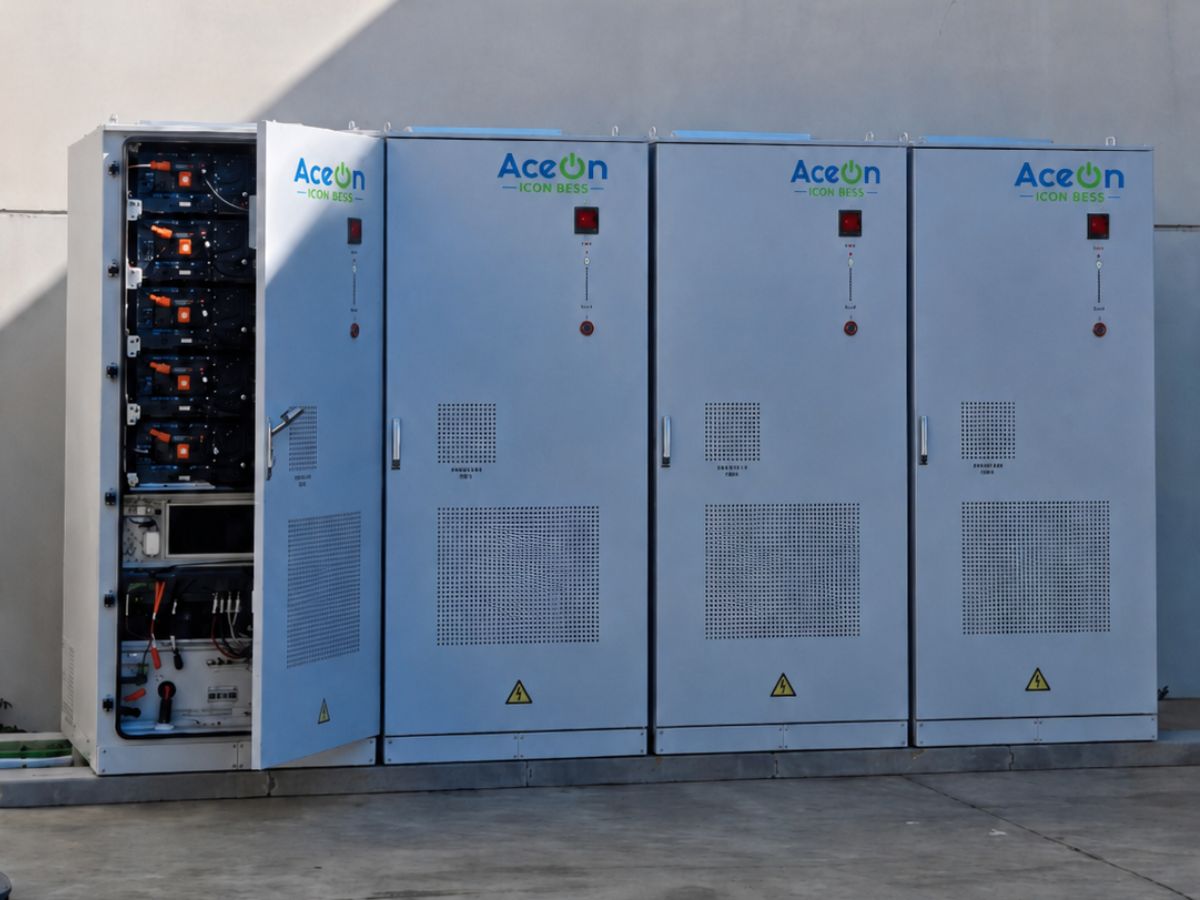
All-in-One Battery Storage System
The iCON 100kW 215kWh Battery Storage System is a fully integrated, on or off grid battery solution that has liquid cooled battery storage (215kWh), inverter (100kW), temperature control and fire safety system all housed within a single outdoor rated IP55 cabinet. This industrial and commercial battery storage system is the ideal compact solution for your battery projects to work alongside solar PV, EV chargers and back up power requirements. Up to 5 battery cabinets can be connected together to create either 200kW 430kWh, 300kW 645kWh, 400kW 860kWh or 500kW 1075kWh battery system.


Inside the iCON Cabinet
iCON internals. 5 * 43kWh Liquid Cooled Modules at the top, 1 * HVAC system, 1* Battery Connection Panel and 1 * 100kW PCS at the bottom

Battery Cell
AceOn's battery storage systems rely on advanced LFP chemistry to provide a combination of high-power performance, low cost, and industry-leading safety. Flexible configuration to serve application scenarios, 3.2V 280Ah prismatic cells became AceOn's best pick for a battery storage solution.
 Lower fire risk, no explosion risk, higher safety
 Advanced thermal design
 Active protection: short circuit, over-charging, over-discharging, high temperature, extrusion, and other safety features
 Safety Vent (in the middle of 2 pole of cell)
Metal protected against corrosion, be made of aluminum
Safety Vent (in the middle of 2 pole of cell)
Metal protected against corrosion, be made of aluminum
 Self-discharge rate:Per month ≤3.0%

Battery Module
Modular design which allows for customized configurations, ease of maintenance, and future expansion capability. Modules are formed by configuring 48 of LFP cells in series connection. Modules connected with a battery management system (BMU) to form a rack-mountable module assembly. Multiple module assemblies are then combined into a rack. Each rack contains rack-level BMS.
The positive and negative interface of the battery modules are provided with obvious marks, are convenient to connect, visual check, examine and repair
The positive sign of the battery module is "+" and the negative sign is "-"
The external contact surface of the battery module is covered by insulating material (Metal protected against corrosion, the top cover is made of PP, the bottom is made of aluminum)
The copper bar and screws are connected internally to prevent short circuit to ensure the electrical safety of the battery module
Each battery module has 16 temperature detectors
Battery Management System
BESS employs a sophisticated, multilevel battery management system (BMS) for system monitoring and control. Each battery management system including:
- Module Battery management unit (BMU)
- Rack battery management system (BCU)
At the lower level is the Module BMS (BMU), which is designed to detect voltage, temperature, and execute cell balance functions for cells. The rack BMS (BCU) can manage all module BMS units and detects total voltage, current, and executes protection functions by switching DC-contactor as well as interact with PCS by RS485 to perform power limits. Finally, local controller manages rack BMS units (BCU) and PCS. What's more, the local controller reserve the Ethernet port (default) or the Cabinet equipped with 4G module (optional) connect the cloud platform or App for customer's real time monitoring.
System Architecture Diagram

Power Distribution & Control
Battery Connection Panel
The main cabinet has a BCP with a power distribution and convergence function. Customers can connect to the main cabinet to get the power. The power distribution part plays a role in protecting the normal operation of the entire system.
It provides auxiliary power for following equipment:
- Battery Management System
- Components inside the high voltage box
- Air conditioning
- EMS control system
- PCS system
- Other auxiliary power supply equipment
Controller
To offer a universal interface for communication between iCON All-in-one systems and SCADA or EMS and release EMS from basic system protection, we deploy a local controller as part of the BESS integration.
- Control integration of the battery system (include battery BMS, cooling units, PCS etc.)
- Offer a universal interface for communication between All-in-one systems and SCADA or EMS.
- Supports RS-485, CAN, dry contact, Ethernet communication and easy integration
- Data logging (short period) for trouble shooting
- Remote firmware updating
Communication Topology

Liquid Cooling System
The liquid cooling system is small in size and equipped on each rack.
Advantages of Liquid Cooling
Higher cooling capability
compare to air cooling, liquid cooling is capable of taking more heat away from batteries under the same condition. And liquid cooling is the best choice when thermal density is beyond the capability of air cooling.
Better temperature uniformity
Cooling liquid has a specific heat capacity which leads to a smaller temperature rise during the cooling process. Therefore, battery cells will have a smaller temperature difference with liquid cooling.

Lower Noise Emission
Without fans on battery modules for air cooling means no noise emission from battery modules.

Working principle of Liquid Cooling
Working principle of Liquid Cooling
Battery Cooling
Cooling liquid powered by the pump will circulate inside battery modules and take the heat from batteries. When the liquid gets out of the battery modules, it became hot liquid with the heat from batteries. The hot liquid will circle back to a heat exchanging tank.
Heat Exchanging
Inside the heat exchange tank, the refrigerant will vaporize from liquid state to gaseous state. During this state/phase change process, the refrigerant will absorb a huge amount of heat from the battery cooling liquid and cool down the cooling liquid.
AC Cooling
The rest of the system is a standard Air Conditioner which releases the heat to the environment through the phase change of the refrigerant.
Fire Suppression and Detection System
Type of Fire Protection
The outdoor cabinet has a separate and relatively sealed space. According to the working principle of the energy storage system and other related technical characteristics, aerosol fire extinguishers and smoke detectors are installed. The fire extinguisher will automatically release aerosols and send a signal to the control panel when the internal temperature reaches 74 °C (162 °F). After releasing, the pressure sensor will send a signal to the Fire Control Panel to report the release event. In a separate loop, the smoke detector sends a signal to the control panel after sensing smoke. Smoke detection is normally reported before aerosol release. Upon receipt of either signal, the fire control panel sends an alarm to the fire mainframe and triggers a light and sound alarm.
Fire Detection & Suppression System Diagram
