
SMARTPOWER project shows how tidal and wave energy, modular battery storage and swappable battery packs can support zero-emission marine operations.
AceOn Group has helped deliver a clean maritime power system that uses tidal and wave energy to charge swappable battery packs for electric boats, addressing one of the practical barriers to zero-emission marine operations: where the charging energy actually comes from.
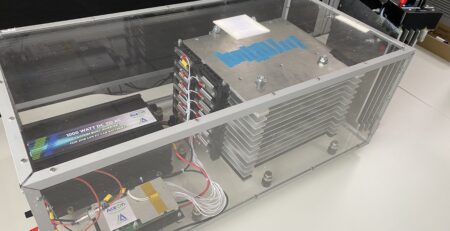
Delivered through the SMARTPOWER project, the system combines tidal and wave energy generation, modular charging infrastructure, second-life EV batteries and portable energy storage. AceOn led the battery integration and overall power architecture, applying the same capabilities the company uses across its commercial battery energy storage and custom battery pack work.
The project builds directly on AceOn’s involvement in RESTORE, one of the UK’s first successful trials of a hybrid hydrogen and battery retrofit propulsion system, demonstrated aboard Newcastle University’s Princess Royal research vessel.
A new model for clean maritime power
SMARTPOWER is designed for coastal and estuarine environments, where grid connections can be limited and diesel generation is often the default. By pairing renewable generation with on-site battery storage and modular charging, the system delivers off-grid power to ports, ferry terminals and marine operators — without the cost or planning complexity of new grid infrastructure.
A practical charging model for electric boats
Battery-electric propulsion is gaining traction in marine applications, but charging remains a constraint — particularly in coastal and remote locations where grid capacity is limited or expensive to extend. SMARTPOWER addresses this by showing how locally generated renewable energy can be stored on-site and used to charge modular battery packs.
The prototype used a swappable battery approach where operators can change packs in minutes, extending operating range and removing the charging downtime that often constrains commercial use of electric vessels.
Lower-cost, lower-emission marine power
Project modelling indicates conventional diesel marine power can cost £0.30 to £0.50 per kWh. The SMARTPOWER model has the potential to bring that below £0.20 per kWh when deployed at scale, while cutting emissions, noise and fuel dependency.
A consortium delivery
SMARTPOWER is led by Taurus Engineering, with AceOn Group, Newcastle University and the University of Liverpool. Partner roles:
- Taurus Engineering — vessel fabrication, energy pontoon development and deployment trials
- AceOn Group — battery integration, second-life EV battery systems and overall power architecture
- Newcastle University and the University of Liverpool — marine engineering, system validation and testing
The project supports wider UK efforts to decarbonise domestic shipping, port operations and marine transport.
“SMARTPOWER tackles the part of marine electrification that often gets overlooked — where the clean energy actually comes from. Combining tidal and wave generation, second-life EV batteries and modular storage gives us a system that cuts emissions and operating costs without relying on grid extension. Following our work on RESTORE, this gives AceOn a proven battery integration capability across both vessel propulsion and shore-side charging.”
Mark Thompson, CEO, AceOn Group
“This is the kind of project the UK should be doing more of. SMARTPOWER pulls together North East manufacturing, battery integration and university research to build clean marine technology that can be made here, deployed here and exported. We’ve got big plans to scale this capability and open new export markets — keeping British manufacturing at the centre of where these systems get built.”
Josh Turnbull, Director, Taurus Engineering
Looking ahead
With the demonstration phase complete, the consortium is exploring how the SMARTPOWER approach extends to fully electric and hybrid electric vessels. The modular, swappable battery model is well suited to ferry, harbour craft and small commercial fleet applications, where rapid pack-swapping can replace long charging windows and second-life EV batteries can deliver lower lifetime costs.
For AceOn, the project extends a marine battery integration capability already proven through RESTORE.